
Dear You,
The first time I went out to dinner after the appetite went quiet, I ordered what I always ordered, ate four bites, and spent the next forty minutes rearranging a plate of pasta so it looked like progress. The server asked if everything was okay three times. I said yes three times. It was not a relaxing evening.
Two years later I eat out often and enjoy it. Here is what changed, in the order you’ll need it on a Friday night.
Before you sit down
Look at the menu online if you can. Not to plan every bite, but so you aren’t reading a four-page menu while hungry people wait and the server hovers. I’m looking for three things: appetizers that are really small mains, sides that come alone, and anything described as “for the table” that I could quietly make my own.
If it’s a tasting menu or a fixed-price place, I say something when I book. “One of us eats very small portions, is there flexibility?” Most kitchens would rather know in advance than watch a plate come back untouched.
At the table
Appetizers are mains now. A crab cake, a bowl of soup, a plate of grilled shrimp, a half order of anything: these are dinner-sized for me. Nobody at a restaurant has ever cared that I ordered from the first page. The menu is a list of food, not a set of rules.
Share without announcing it. If I’m with people I trust, I’ll say “want to split the salmon?” If I’m with people who’d make it a conversation, I order my own small thing and offer bites. I don’t open with a speech about my appetite. The table doesn’t need the briefing.
The two sentences I say to a server. When I order: “I’ll have the soup as my main, please, and could you bring it out with everyone’s entrees?” And when the plate arrives: “Could I get a box when you have a second?” That’s it. Asking for the box at the start tells them, without explanation, that I’m not going to finish and it isn’t a complaint. Servers have seen everything. A small eater is not news.
Order the thing you actually want. Four bites of something wonderful beats a full plate of something sensible. This was the hardest adjustment, honestly. Years of ordering the “good” option, and now the appetite is small enough that there’s no room for a sensible choice. The bites have to be worth it. The scallops, then. The thing with the brown butter.
Put the fork down between bites. Not as a technique. Because the fullness arrives later than it used to and arrives all at once, and I’ve learned the hard way that the bite that tips me over feels fine going in. I order a sparkling water with the meal so I have something to do with my hands.
The box, and the apology I retired
For about six months I apologized every time I left food. “Sorry, I’m just not that hungry.” “Sorry, it was great, I just…” I was apologizing to servers, to friends, once to a busboy who hadn’t asked.
I stopped when a friend pointed out that I’d apologized four times in one dinner, and none of those people were owed an explanation for the contents of my stomach. She was right. Leaving food isn’t rude. Leaving food in a box is just lunch tomorrow.
Now the box comes, I put the leftovers in it, and I say “that was great, thank you.” Which is true, and complete, and takes two seconds.
When it still goes wrong
Sometimes a dish arrives and it’s enormous and everyone’s watching and the old panic flickers. I take three good bites, put my fork down, and join the conversation. The plate can sit there. Nobody at a dinner table is actually monitoring your consumption, and the ones who are have their own stuff going on.
This is one person’s way of doing it. Your appetite, your table, your rules. But if you take one thing: ask for the box when the plate arrives. It changed how I feel about restaurants more than anything else on this list.

Want to tell me something? Reply to any Low Volume email, or write to me here. I read everything.
Getting Quiet shares lived experience, general education, and practical tools. For medical decisions and individual treatment questions, talk with your qualified care team.
 Ayden, founder of Getting Quiet. Read the story →
More on Life around a table
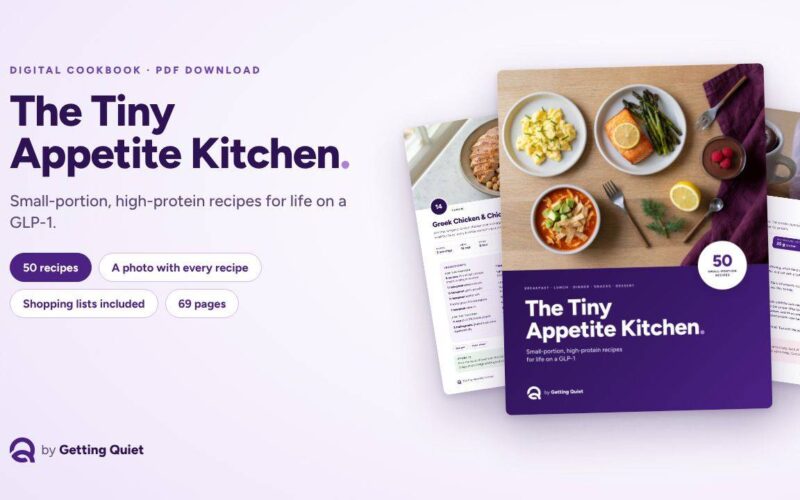
The Tiny Appetite Kitchen is here.
Fifty small-portion, high-protein recipes for the appetite you actually have. The cookbook I needed at week six is out today.
The holiday table, in advance
A food holiday on a quiet appetite, planned ahead: eat something small first, bring the protein, take the small plate, and have one sentence ready for the relative.
Hosting dinner when you can’t eat much of it
Why I still host with a tiny appetite. The three-part menu that works for every eater, the host's small plate, and the useful trick of being busy in the kitchen.