
Dear You,
Thanksgiving used to be my Super Bowl. I trained for it. I skipped breakfast, arrived hungry, and treated the buffet like a personal challenge I intended to win.
The first holiday on the medication, I did the same thing out of habit and it went badly. I showed up with an empty stomach that wasn’t hungry, got overwhelmed by the sheer volume of a table built for twelve, took a plate I couldn’t finish, and spent the afternoon fielding questions about why I’d barely touched my aunt’s sweet potatoes. Great day. Highly recommend not doing that.
Here’s what I do now. One person’s playbook, adjust for your own family.
Before you go
Eat something small two hours before. A yogurt, a few slices of turkey from the deli counter, an egg. It sounds backwards to eat before a feast, but a quiet appetite doesn’t get hungrier by waiting, it just gets more fragile. Arriving with something in your stomach means the first smell of gravy doesn’t knock you sideways.
Decide your two. Before you walk in, pick the two dishes you actually care about. For me it’s the dressing and whatever my cousin does to green beans. Everything else is optional. You are not obligated to sample the whole table out of politeness. Nobody’s keeping score except you.
Bring a dish that works for you. This is the move that changed everything. I bring a protein. Not a casserole, not a dessert. A sliced roast, a platter of deviled eggs, a tray of marinated shrimp, something I can put three pieces of on my plate and feel fed. It fills a real gap on most holiday tables, which tend toward starch and sugar, and it guarantees there is one thing in the room my body is happy with. Also, people love you for bringing protein. It’s the dish that runs out.
At the table
Use the small plate. Every house has them, the salad or dessert size. Take that one, fill it fully, and go sit down. A full small plate reads as participation. A sparse dinner plate reads as a statement, and people will ask about it.
Protein first, then the two dishes you chose, then one bite of anything you’re curious about. Eat slowly. Put the fork down between bites, not because a diet told you to, but because the medication means your “full” arrives late and loud, and you want to hear it coming.
Seconds are allowed. You might not want them. Both outcomes are fine.
Then there’s the relative. There is always one. “Is that all you’re eating?” “You’ve gotten so thin, are you sick?” “Just have a little more, I made it for you.”
Have a sentence ready. Mine is: “I’m pacing myself, there’s pie coming.” It’s cheerful, it’s true, and it closes the topic. Other sentences that work: “I ate a big breakfast.” “I’m saving room.” “I’m good, thank you, this is delicious.” Say it, smile, change the subject to their grandchild.
You don’t owe anyone the medication conversation at the table. If you want to have it, have it on the porch with the one person you trust, not over the gravy boat with everyone listening.
Leaving
Leftovers are where this all pays off. Ask for a small container of the protein and one of the dishes you loved. Skip the mountain of rolls someone tries to send you home with. A small appetite means those leftovers will stretch for days, and tomorrow’s lunch of cold turkey and cousin’s green beans is the real holiday meal anyway. Eaten alone, in your own kitchen, at your own pace, with nobody asking questions.
That’s the whole plan. Eat before. Bring protein. Small plate. One sentence for the relative. Take home what you’ll eat. And when you catch yourself halfway through the afternoon, pleasantly full and not thinking about food at all, notice it. That used to be unimaginable.

Want to tell me something? Reply to any Low Volume email, or write to me here. I read everything.
Getting Quiet shares lived experience, general education, and practical tools. For medical decisions and individual treatment questions, talk with your qualified care team.
 Ayden, founder of Getting Quiet. Read the story →
More on Life around a table
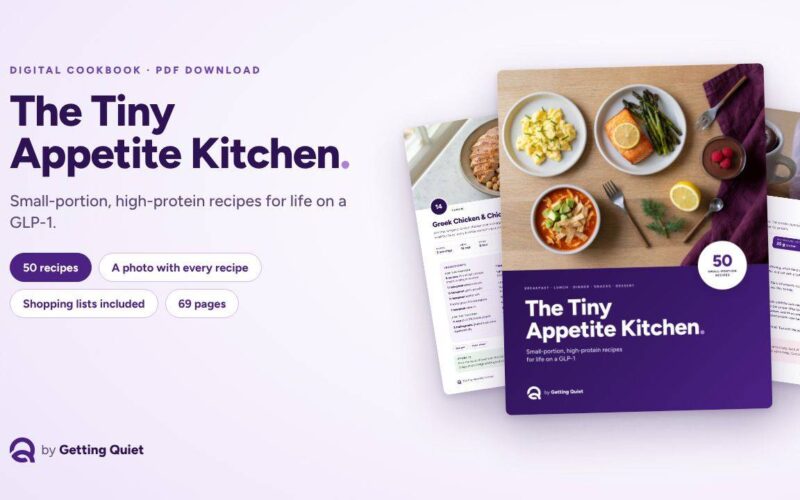
The Tiny Appetite Kitchen is here.
Fifty small-portion, high-protein recipes for the appetite you actually have. The cookbook I needed at week six is out today.
Hosting dinner when you can’t eat much of it
Why I still host with a tiny appetite. The three-part menu that works for every eater, the host's small plate, and the useful trick of being busy in the kitchen.
Dating when dinner is the date
First dates built around food, with a tiny appetite. How I pick the place, what I order, when the medication comes up, and the man who ordered two desserts.