
Dear You,
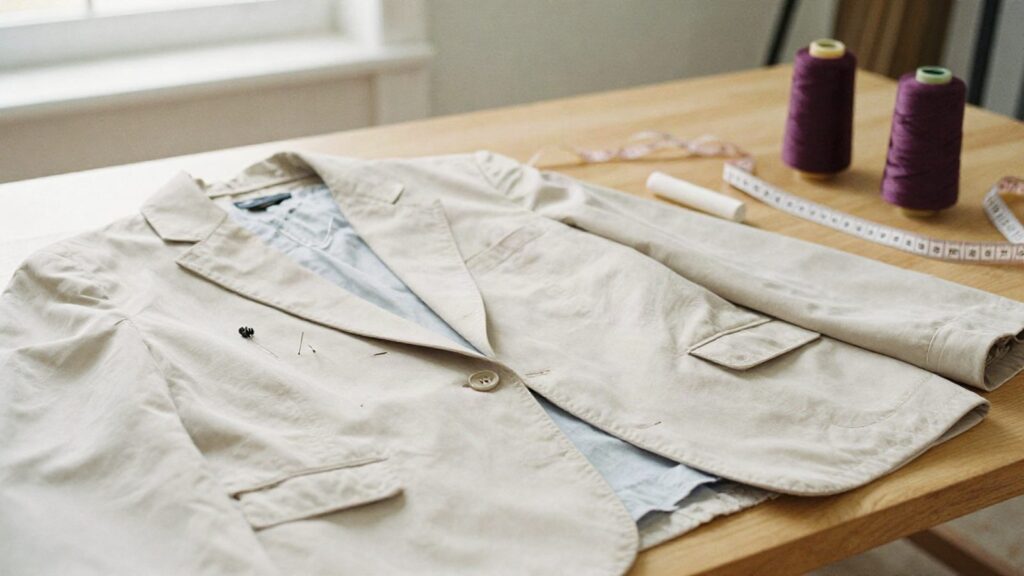
At one point during the first year, I owned four sizes of the same navy blazer. That is not a wardrobe. That is a museum of a man in transition, and it cost me a fortune.
Then a friend who works in menswear said the sentence that changed my closet: “Why are you buying new? Take it to a tailor.” I had assumed tailoring was for suits and weddings. It’s for jeans, too. Here’s what I learned, in plain terms, from a tailor named Rosa who has seen every version of me.
What a tailor can do
- Take in the waist of trousers and jeans, usually two or three inches, sometimes more if the back pockets don’t end up kissing.
- Taper legs, shorten hems, and slim a shirt through the body and sleeves.
- Move buttons on a blazer or coat, take in the sides, shorten sleeves.
- Add darts to the back of a shirt that balloons.
- Take in a shirt enough that a collar that used to gape looks intentional again.
What a tailor can’t do
- Fix shoulders cheaply. If a jacket’s shoulder seam sits an inch past your actual shoulder, that’s a rebuild and it costs more than the jacket is worth. Shoulders are the one thing I now buy to fit.
- Make a garment bigger beyond the seam allowance, which is usually under an inch.
- Save jeans that need five inches out of the waist. The pockets migrate to the back and the proportions go odd. Rosa will tell you this gently and then suggest one new pair.
- Change the rise of trousers. Where the waistband sits is where it sits.
What it costs
In my city, with Rosa: hemming trousers runs about the price of a nice lunch. Taking in a waist is about twice that. Slimming a dress shirt is around the same as the waist. A blazer taken in through the body and sleeves is about the price of a decent dinner for two. Compared to replacing the blazer, it’s not close.
Dry cleaners who offer alterations are often cheaper and fine for hems. For anything structured, find someone whose whole job is tailoring. Ask the best-dressed person you know where they go. They will be thrilled you asked.
How to talk to a tailor
Wear the shoes you’d wear with the garment. Bring the belt. Stand normally; don’t suck in. Tell them how you want it to feel, not how many inches: “I want this to skim, not cling” is more useful to Rosa than a number. Ask “what would you do with this?” and then listen. Ask the price before they pin. Pick things up on time; they’re small businesses.
And if you’re mid-change and expect to shrink again, say so. A good tailor will take in less than they could and leave the seam allowance for the next round. Rosa took my jeans in twice, and the second time was cheaper because she’d planned for it.
Which pieces are worth it
Anything well made that you love. Good denim. Wool trousers. Coats and blazers whose shoulders still fit. Dress shirts you’d otherwise replace at full price. Not worth it: fast-fashion tees, anything with a lot of stretch that will just re-stretch, cheap trousers where the alteration costs more than the pants did.
The three I kept through every size
A black wool overcoat, taken in twice through the body, shoulders still perfect because I’d bought it slightly narrow years ago by accident. A pair of raw denim jeans, waist taken in and legs tapered, which now fit like they were made for me because, at this point, they were. And a grey cashmere sweater that fit at every size because sweaters are forgiving, and because some things in your closet should be allowed to just love you.
Everything else I let go, in batches, to a consignment shop and a friend’s nephew. Three garments made it the whole way. They cost me less in alterations than one of those four navy blazers.
Want to tell me something? Reply to any Low Volume email, or write to me here. I read everything.
Getting Quiet shares lived experience, general education, and practical tools. For medical decisions and individual treatment questions, talk with your qualified care team.
 Ayden, founder of Getting Quiet. Read the story →
More on Same person, different fitting room
Being seen, and the strange discomfort of attention
People look at me differently now, and I flinched, then felt guilty for flinching. On a nervous system running an old program, and learning to take my coat off.
The gym at a new size
Walking into a gym feeling like an impostor in two directions, the first month of lifting badly, and the trainer who fixed my elbow and never asked why.

The same person in a smaller chair
Being treated differently, the discomfort of being seen, and the parts that didn't change at all. Not a transformation story. A continuity story.