Dear You,
The prescription came with instructions. Life was apparently sold separately, and so, it turns out, were pants.
Nobody tells you how often you’ll be standing in a fitting room under that specific lighting, holding a size you have no reference for, wondering whether to buy the thing that fits today or the thing that might fit in March. I did this wrong for about a year. Here is what I eventually landed on. It’s practical, not profound, and it’s one person’s closet, not a rule.
Buy in stages, not seasons
For the first long stretch, I bought as if my body were a rental. Not because anything was temporary, but because nothing was settled. That meant:
- Shop every six to eight weeks, not every six months.
- Buy for the body in the mirror, not the body in the plan. Clothes that fit today get worn today. Clothes bought for a future version sit in the bag with the tags on, quietly judging.
- Accept that “fits” is a moving target, and that’s not a failure of the clothes or of you.
The three-item rule
Each trip, I bought three things that fit right now: one for work, one for the weekend, one I actually liked. That’s it. Three items will carry you for weeks, cost less than a panic haul, and spare you the drawer of eleven near-misses.
The “one I actually liked” matters more than it sounds. If every purchase is utilitarian, the whole thing starts to feel like being outfitted for a job you didn’t apply for. One shirt that makes you feel like yourself does a lot of quiet work.
Tailoring is a bridge, not a luxury
A tailor will take in a pair of trousers or a blazer for less than the cost of a replacement, and the result fits better than anything off the rack ever did. I found a dry cleaner with an alterations counter four blocks from my office. The woman there has seen me more often than some of my relatives.
What’s worth tailoring: anything structured, anything you love, anything that cost real money the first time. What isn’t: t-shirts, basic knits, anything with elastic doing the heavy lifting.
Where cheap is fine and where it isn’t
Cheap is fine for: t-shirts, basic layering pieces, gym clothes, pajamas, anything you’ll wear for two months and not miss. Buy the three-pack. Nobody at the 7 pm reservation is checking the label on your undershirt.
Cheap is not fine for: shoes, a belt, one good jacket, and anything that touches your skin all day in a hot month. Feet don’t change much; buy the shoes once, properly. A good belt lets a pair of trousers survive two sizes of change with some dignity. One jacket that fits well makes everything underneath it look intentional.
The old closet, without the ceremony
There is a genre of content where someone lays all their old clothes on the bed, cries a little, and donates everything in a single afternoon of triumph. I’m not knocking it. It just wasn’t me, and if it isn’t you either, you’re allowed to skip it.
What I did instead:
- Anything I hadn’t worn in three months went into a bin in the hall closet. Not gone. Just out of the daily rotation.
- Three months later, I opened the bin. Anything I hadn’t thought about went to donation. Anything I’d missed came back out.
- I kept exactly two things from the old closet on purpose. A coat I love, which the tailor took in twice. And one shirt, unaltered, in the back, because it’s mine and I don’t owe anyone a reason.
No ceremony. No photo for the internet. A bin, a quarter, a decision.
One more thing about the mirror
Fitting rooms are not neutral. The lighting is cruel, the mirrors are angled, and you’re usually tired. If you leave one feeling worse than you went in, that’s about the room, not about the body in it. Go home, try the three things on in your own light, and decide there.
Want to tell me something? Reply to any Low Volume email, or write to me here. I read everything.
Getting Quiet shares lived experience, general education, and practical tools. For medical decisions and individual treatment questions, talk with your qualified care team.
 Ayden, founder of Getting Quiet. Read the story →
More on Same person, different fitting room
Being seen, and the strange discomfort of attention
People look at me differently now, and I flinched, then felt guilty for flinching. On a nervous system running an old program, and learning to take my coat off.
The gym at a new size
Walking into a gym feeling like an impostor in two directions, the first month of lifting badly, and the trainer who fixed my elbow and never asked why.
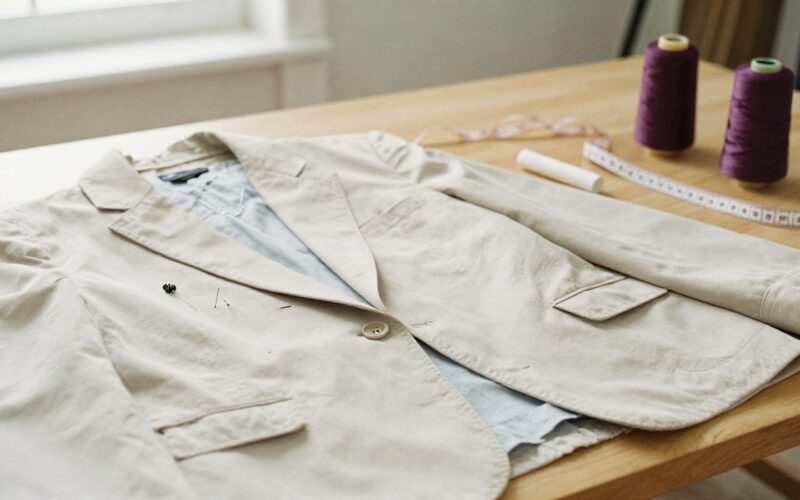
Tailoring is cheaper than a new wardrobe
What a tailor can and can't fix, what it costs, how to talk to one, which pieces are worth it, and the three garments that made it through every size.